Monday, 25 May 2009

Ur-ine trouble if you've been eating asparagus

I was reading last week in Hugh Fearnley-Whittingstall's delightful food column that asparagus is in season again. I really enjoy this whole eating in-season produce and being eco-responsible lark (despite it being so fashionable it almost makes you cringe). It's great; you get to eat really fresh food which is also quite cheap, since there's loads of it around.


Asparagus stalks in the wild


So I've been tucking in to the zingy spears all week and have been loving it. I was surprised to learn from a friend who had been similarly glutting-out on asparagus, that he also always enjoys eating asparagus, since 'it always makes my wee smell all mental.' I was surprised by this as I had experienced no real bathroom shocks, asparagus-related or otherwise, over the past few days.

But enough of this cheap toilet humour. As usual I needed to quench my insatiable thirst for scientific knowledge (or something) so I set about finding out what causes these magic odours which some people can smell and some can't.

First off, it is clear that a chemical of some sort is responsible. Scientists generally agree the one causing the grievance in this case is methyl mercaptan.

As an interesting aside though, unlike our other senses, smell is not really that well understood by scientists. We know how things like vision, touch and hearing work in quite a lot of detail, but smell remains something of an enigma.

We do know that there are various receptors in our noses, and it seems obvious that these mediate smell in some way. So far though, it has proved difficult for scientists to work out their exact structures. (Conversely, we do know the structures of lots of other proteins, for example opsin, as shown in the recent benchtwentyone article on retinal). To add to the confusion several molecules which have similar structures have wildly different scents. Conversely, molecules of vastly different sizes and shapes can sometimes smell very similar (figure 1). As a result of this confusion, there have been several not-widely-accepted theories of smelling even relatively lately [1].

Most receptors in the body are large proteins. These mediate everything from the digestion of food to the degradation of neurotransmitters and work on the theory of 'lock and key'. This means the cleft in the center of the protein has a specific shape and size which binds only a particular guest. But if this is the case for odourants, we would expect similar molecules to smell the same - which is not always the case.


Figure 1

Methyl mercaptan (the guilty party derrived from asparagus) and ethane dithiol are both sulfurous compounds which smell awful; like rotten eggs. Acetophenone has a relatively small methyl group compared to benzophenone which is much larger. They both smell similar though - people tend to describe the odour as a lot like burnt almonds.


To get back to asparagus though, it seems there are two possible explanations for the discrepancy between mine and my friend's post-asparagus wee. The first option is that one of us has a particular enzyme or bacteria in our intestinal tract which breaks down a compound present in asparagus to methyl mercaptan and the other doesn't. This might make quite good sense, as naturally occurring amino acids which contain sulfur (such as methionine) are known to be broken down in the mouth to methyl mercaptan by bacteria [2], causing bad breath. The alternative is that we both have the compound in our urine, but I don't have the correct receptors in my nose to smell it.

Stopping short of inviting my contact into a slightly too close for comfort wee smelling investigation, I consuted the British Medical Journal and found that the experiment had already been done by the professionals [3]. The researchers in question found that the chemical was present in the urine of all the 203 asparagus-fed volunteers they investigated. Also, when presented with samples of an 'unknown liquid' (the researchers obviously felt it wouldn't be proper to reveal it's true identity) the volunteers who could smell the guilty chemical in their own urine could smell it also in everyone else's.

So like it or not, if you're like me and have been chowing down on asparagus all week, you're going to have some seriously funky bathroom smells sometime soon.

[1] L. Turin, Chem. Senses., 1995, 773 - 790

[2] T. Koga etal., Infection and Immunity, 2000, 68 (12), 6912-6916.

[3] M. Lison, S. H. Blondheim and R. N. Melmed, British Medical Journal, 1980, 281, 20 - 27.

Friday, 1 May 2009

Paradigm shifts

Some scientists like to think that they pressume nothing, and have the cold pursuit of facts as their only rule. In fact this is largely nonsense. If we really stop to think about it we realise that all knowledge is based on certain assumptions and approximations. In lots of cases (most, even) these assumptions are reliable and good, but what happens when something occurs which contradicts all our percieved limitations?
A few years back a man called Thomas Kuhn demonstrated what can happen by cheekily constructing a deck of playing cards in which the suits of hearts and diamonds were coloured black and the clubs and spades were red - this of course going against the whole mind set you automatically take on as soon as you glimpse a pack of small cards with that characteristic pattern on their backs. Kuhn conducted an experiment where he quickly flashed random cards at his subjects, who he asked to try and identify them. He found most people identified the black cards as either spades or clubs automatically, even though they weren't, but displayed some degree of brow-furrowing. The second time round people were utterly confused and some even became angry. He even cited one of his subjects as crying and screaming hysterically, such was her distress at realising that somehow everything she thought she knew about cards was suddenly and inexplicably wrong with no apparent explanantion.
Kuhn conducted this experiment in order to try and illustrate his theory of 'paradigm shifts' and wrote it up in his 1962 book The Structure of Scientific Revoloutions. A historian by trade, Kuhn believed that scientists (like all of us) make a set of assumptions about their field of research. This could be based on the previous work done, where and by whom you have been taught or just on random prejudices. Generally this set of rules is shared by the majority of informed people in a field and forms what Kuhn dubbed a paradigm. A paradigm then, is like a window, the assumptions we make about things like the sills which frame the view. A paradigm shift is what happens when suddenly someone finds out something which they can't explain using the current scientifc theories - the window frame shifts to make room for new ideas.
Paradigm shifts have occured on a global scale lots of times in history as Kuhn expertly details in his book. For example it must have been one heck of a shock when one day a bloke called Nicolaus Copernicus came along and told everyone that in fact it was not the earth which was at the centre of the universe, but the sun (of course, we now know that's not exactly the full picture either). Equally, when scientists such as Bohr, Einstein and Planck started observing that the laws of nature which work for very large objects (like footballs and planets) didn't work for very small objects (like electrons and atoms) they found they needed new laws to explain what they were seeing. We now call that quantum mechanics.
Some argue that we are currently moving from a modern to a post-modern era and this is a form of cultural paradigm shift. Modernism was characterised by the formation of large, characterless conglomerations and as a result the making of large sums of money. Post-modernism is rather the opposite: a distrust of organised bodies of all kinds (especially the government and especially the financial systems) and a search for a more personal and resonant meaning and truth.
There are paradigm shifts going on all over the place. Now you know what they are you can try and spot one and tell someone else. You'll make yourself look very intellectual. Either that or just appear wierd and alienate yourself a little.

Monday, 27 April 2009

The Hayfever Machine


Many, many, many of us in the UK suffer from hayfever and I, your intrepid science crusader, am one of them.

Hayfever (seasonal allergic rhinitis) occurs when an allergen such as pollen gets into our system and comes into contact with a white blood cell (specifically, mast cells). Usually this doesn't cause much of a problem, but in people with allergies these cells have become hypersenstised and go rather mental, releasing an awful lot of histamine.


Histamine - the cause of our collective misery

Histamine is an important chemical in our bodies. It regulates sleep to some degree (which is why when you take antihistamines the boxes always warns you not to use heavy machinery afterwards - there's a small chance you could fall asleep) and has been shown to be released during sex too. Great.

Unfortuantely for us snivellers, it has a much more obvious role which is to act as an inflammatory agent. In principle this is good as when something horrid gets into our bodies we generally need to have our noses run (so that all the bad stuff, er, flows out) and our blood vessels inflammed (so that more blood carrying bug-eating cells get to the danger zone).

It's just a shame for me and my fellow sufferers that our bodies have declared war on ice creams in the park, wimbledon, a sunday afternoon stroll by the river and genereally anything else that involes being vaguely near grass during the summer months.

Since I was a boy I have been dosed up to the eyeballs from the end of April 'til arond September with prescription antihistamine medicines. I then switched Pfizer's expensive wonder cure Benadryl (mainly captivated by the adverts involving SWAT teams in helicopters swooping to the rescue of an atishooing sufferer). I've now cottoned on that a cheap antihistamine plus some decongestants will get rid of most of my symptoms. This does still add up however.

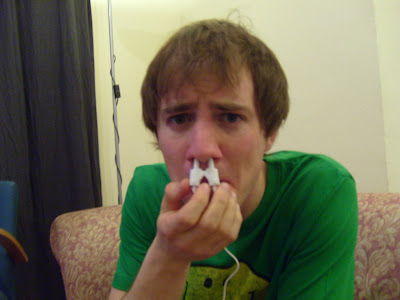
I've now received in the post what I dub 'the hayfever machine' which claims to be able to relieve the horrors of this condition using nothing more than a red light bulb. Of course there is the slight issue that in order to use it you have to sacrifice any iota of cool you may have (in my situation as a PhD Chemist this is more or less irrelevant, but still there is a duty to report, I feel) and cram two bulb-encasing prongs into your nostrils. These two prongs have red LEDs on their ends. You sit, uncomfortably, for three minutes, up to four times a day with these fellows in your nose and the light pouring in. The manufacturers claim it's 'safe, quick and easy to use and some sufferers will notice an improvement after just a few treatments'.


I sacrifice my last iota of 'cool'


Is there any evidence that this contraption works? One study I peroused (1) stated that after following the recommended course of treatment with the machine 72% of subjects felt their symptoms had been reduced and the study coordinators even went to the lengths of conducting an endoscopy (that is, sticking a miniture camera up the patients noses) and managed to confirm pictorially that this was the case for 70% of them.

How does this treatment work? In two ways apparently and by emmitting light of two different wavelengths. One wavelength of around 635 nanometers interacts with a light-absorbing chromophore (see article on Rhodopsin) in the white blood cells which causes a complex biological cascade of reactions which have been found to stabilise the cells and reduce histamine release. The second wavelength induces a dilation of nasal blood vessels which helps bring our bodies back to their resting state (2, 3).

I'll be reporting my degree of hayfever-induced misery on benchtwentyone as I begin using the device and we'll soon see if there's any truth in these claims.

Roll on summer.

References


(1) I. Neuman and Y. Finkelstein, Narrow-band red light phototherapy in perrenial allergic rhinits and nasal polyposis, Ann. Allergy Asthma Immunol., April 1997, 78, (4), 399 - 406.

(2) E. N. Goncharenko et. al., Bull. Exp. Bio. Medicine, effect of middle wave ultra violet and red light on degranulation peritonial mast cells in rats, 2006, 129, (4), 357 - 358.

(3) http://www.lazrpulsr.com/files/How_does_light_therapy_work.htm

Monday, 20 April 2009


Melatonin (or Sleepstacy)

Molecule of the month, April 2009


This month the molecule I have been wasting my time thinking about while I should have been doing my PhD is melatonin. The compound is a neurotransmitter which causes us to begin to feel sleepy. It regulates our circadian rhythm: our sleep - wake cycle. In terms of its molecular structure melatonin is a lot like serotonin, the chemical messenger which makes us feel happy. This is interesting in itself - such subtle changes in molecular structure can have huge implications on how a chemical acts on biological systems.


Melatonin and serotonin are very similar in terms of their chemical structure. The hydroxyl and amine groups of serotonin have been methylated and acetylated respectively to give melatonin.


Melatonin and Serotonin are made in the body from the amino acid typtophan. This is an 'essential' amino acid, which means we have to consume it in food - it can't be constructed from simpler molecules in the body. Essential is the word though, since without tryptophan we would be without these two brutes above. So we couldn't sleep and we would never be happy.

The production of melatonin, which takes place in the pineal gland in the brain, is dependant on light. The darker it gets, the more melatonin we begin to produce and the sleepier we begin to feel. Scientists have linked melatonin production levels to the onset of late night activity of adolescents. It appears that around the age of 14 the onset of serious melatonin production begins to become delayed until later in the evening, meaning those crazy kids just don't feel tired at all. Some scientists speculate that this is due to the increased use of screens to play video games, write homework assignments and watch TV during the twilight hours. All that light beaming into childrens eyes, sends the message that it's still bright as day, and there's no need to feel tired yet. Or so runs the theory.


An adolescent brain is a complicated thing, but we can be certain of one thing at least - the Pineal gland is situated near the centre of it


Scientists can’t say for sure though whether teenagers begin to stay up late, and as a consequence their melatonin levels begin to elevate later in the evening, or if the melatonin levels drop off first.

Interestingly, since melatonin production is mainly inhibited by blue light (which has a wavelength of between approximately 450 and 495 nanometres), scientists have had some success in treating insomniacs by instructing them to wear blue tinted sunglasses during the evening. These stop the blue light entering the eyes and trigger the onset of melatonin production.

Disrupted sleeping patterns are a massive source of misery for a significant number of people. 20% of Americans, for example, suffer from sleep disorders. A lack of sleep can lead to what's called secondary sleep disorders, that is social and physical problems resulting from a lack of sleep.

Fortunately Chemists can make melatonin relatively easily, and partly because of that it’s widely available over the counter in the USA as a tempting looking white powder which can purportedly help people with sleep disorders get a decent period of shut-eye. Unfortunately perhaps, it’s not currently legal to sell melatonin in the UK.

Should this be the case? I decided to take matters into my own hands and try to find out if the stuff works.

My self-experimentation was a horrible distortion of the scientific method though. Generally scientists would like to remove external influences and make sure only the variable you want to test (whether of not melatonin has been taken) is changed. It was unfortunate then that me getting hold of some dissolve-under-the-toungue melatonin lozenges coincided with a visit I had to make to the Lake district - one of the most sleep-inducing places in England.

I was pretty nervous about chomping down on this illegal substance so the first night I was in the Lakes I nervously chewed a quarter of a tablet off. My mind did seem to go swimmier than usual before I dropped off, but I could have just been more tired than usual I suppose. The next night I took a whole one. Again I was asleep in no time and didn't wake up until ten the next morning, but I couldn't be sure if this was just becuase I had walked most of the way up a large hill earlier the previous day.


A good scientists should never lose his nerve during an experiment


So unfortunately I had no real evidence whether melatonin worked or not. Since my crude experiments had served only to provide me a few weak anecdotes for my blog, I turned now to the scientific literature for a more robust opinions on melatonin.

A report recently published in the bristish medical journal conducted a careful review of 13 clinical studies of melatonin use in humans which had been reviewed by an independant expert to ensure their validity. After combining the results of the 13 trials the authors found that melatonin doesn't give people significantly more efficient sleep (based on the proportion of time spent actually asleep whilst in bed) or indeed even help people to get to sleep more quickly.


On the other hand though, this doesn't necessarily mean melatonmin wouldn't work for you. The authors found that lots of people did benefit from melatonin - it was just that, equally, lots didn't. While my melatonin source says taking melatonin is, for him 'like switching off a light' this wasn't the case for me. The question is, I suppose, is this just a placebo effect? Who knows, but if melatonin can give my post-doc supervisor (see below) a good nights sleep - sufficient to prevent him from killing me when I use all his glassware at least - then who am I to critcise it?

-------------------------------------------------------------------------------------------------


Two people have been a massive help to me on this molecule of the month peice, and they're such utter legends that I think a thumbnail sketch is quite in order.

First I turn to Barney Walker, my aforementioned 'grumpy post-doc' (see the about me section). Although I owe Barney quite a debt of gratitude for the fact that he has taught me how to do research chemistry for the last 6 months, I have no qualms when I say he's a morose kind of guy. His mood swings depend mainly on the strength of his morning Starbucks, taken with religious regularity and how well he remembers that he has only 12 weeks to go before moving to the states to be with his girlfriend Gemma. I would also mention that he is large, Scottish and angry. I recently found out that he's one of those people who calls himself by his middle name: real name being Dave. Barney (Dave) supplied me with 'the stuff' for my self experimentation.

Alan Jenners is my second helpmate and is from my church. He contacted me wanting to come and spend a day working in the Davis group research laboratories, so he could find out what it was like being a scientist (for an unrelated project). I refused, on that grounds that he would certainly blow himself up, it's against the rules and it's not a decision I can make anyway. On the upside though, when I suggested he turn researcher for benchtwentyone Jenners jumped at the chance, and when he realised the subject I wanted him to research was melatonin, that was just great - AJ, it turns out, is a sufferer from sleep disorders himself. Illegal sleep drugs to the rescue, Alan?


References

G. E. Bentley, Current Biology, 18, 2008, 736 – 738.

Shipiro et al., J. Clin. Endocrinol. Metab., 5, 2005, 2755 – 2761.

Baker et al., Efficacy and safety of exogenous melatonin for secondary sleep disorders and sleep disorders accompanying sleep restriction: meta-analysis, British medical journal, 2006.

Monday, 16 March 2009

Retinal

Molecule of the month, March 2009


Retinal - this molecule is the reason we are able to see.

Or at least one of them. Retinal, or, more correctly, 11-cis-retinal is a small molecule which fits into the binding site of a large protein called Opsin. Together they make up Rhodopsin, the structure of which is shown below (figure 1). This is where the terms ‘rods’ (think Rhodopsin) and ‘cones’ come from, referring to cells in our eyes which contain rhodosin and isodoposin pigments respectively.


Figure 1. The native form of opsin from bovine rod cellls. The pink bit at the bottom is retinal.

Have you ever noticed when you're in bed and can't sleep that once your eyes have become accustomed to the gloom, you can actually see the outlines of items in the room really quite clearly, but they all look grey and colourless? The reason we can see these outlines is because our rod cells are sensitive to very low levels of light, but can only respond to it in a black and white fashion. The cone cells, which respond to the whole spectrum of colours, require a much higher threshold of light than is present in the dark room to be triggered.

So what makes Rhodosin special as a molecule - how is it that it allows us to see? Firstly, it's important to realise that there is, of course, not just one, but lots of rod cells (about 100 million) all over the retina of our eyes. You can think of them like pixels in a digital camera - each one can only ever be on or off, but when we consider all of the signals in unison we can see a picture.

Retinal itself is what chemists refer to as 'delocalised' - hopefully the graphic below (figure 2) will give you an idea of what we mean by this; the electrons contained in the delocalised system exist in a high energy 'cloud' above and below the plane of the structure.


Figure 2. 'Resonance structures' of retinal - the high energy electrons in the double bonds can flow quickly in the course shown by the arrows. In real-time, retinal exists as a 'resonance hybrid' (bottom) of the left- and right-hand structures.

When a light particle (photon) hits retinal, the double bond at the 11 position changes conformation from -cis to -trans (figure 3). It's obvious from the diagram above that this changes the shape of the molecule. This means it can no longer fit into the cleft into the protein. We can think of the protein 'relaxing', and what happens next is what's known as an enzyme cascade. In other words a complex series of events which ultimately lead to nerves in your brain firing and you seeing an image.


Figure 3. 11-cis-retinal changes shape when it absorbs a photon. The cis ­part comes from the fact that one of the double bonds (at the 11th carbon) has the two largest substituents (that is, the largest chains coming off it) on the same side. The other double bonds are all –trans, or with the bulky substituents positioned on opposite sides. A more modern nomenclature uses the letters E (from the German, entgegen; apart) and Z (from zusammen; together).


Retinal is part of a group of retinoids including retinol (aka vitamin A) and their parent molecule beta-cartotene (figure 4). These compounds are not made in animals, but plants produce lots of them. Interestingly olives, which are distinctly not orange, also contain high concentrations of these molecules (2). This is where the old saying ‘carrots help you see in the dark’ comes from - unless humans get enough retinoids in their diets, they cease to be able to produce retinal. This can result in conditions like the scary sounding ‘night blindness.’ Relax though: this is hard to contract on a sensible diet.


Carrots - a good idea to include in your lunch box, that is if you want to avoid 'night-blindness'.


Figure 4. The retinoids retinal, retinol and beta-carotene (so called because it gives carrots their intense orange colour) are all inter-linked by biosynthetic pathways. NADPH is a biological source of negatively charged hydrogen (hydride).

You may be scrathing your head at this point, thinking, 'where have I been hearing about retinol recently?' Well, since L'Oreal have recently been inundating us with reports of how wonderful Pro-retinol A, their latest miracle skin cream is, this is probably not suprising.

These pro-retinols break down to retinol on exposure to the skin. Vitamin A itself is what does all the work - it is a chemical messenger, one function of which is to instruct cells to begin multiplying more uniformly, and to produce more elastin and collagen: two protein building materials essential in healthy, young-looking skin cells.

I will make no further comment about anti-ageing creams however. Largely because if you're the sort of person who's concerned about whether skin creams are really worth the money (as opposed to assuming they aren't), you're probably not the sort to be reading molecule of the month anyway.

Do take care of your skin though readers, you only get the one.


References

(1) O. P. Ernst et al., Nature, 2008, 454, 183 – 187.

(2) http://www.lenntech.com/fruit-vegetable-vitamin-content.htm (Accessed 27.02.2009)


I have collaborated with Dr. Paul May of the School of Chemistry, University of Bristol to produce a slightly more 'fun' version of this article for a younger audience. This has been published on the School of Chemistry webpages. You can have a look by visiting www.chm.bris.ac.uk/motm/motm.htm and clicking on the relevant link (as of April the 1st).

Monday, 9 March 2009


Josh goes to Parliament


This week I strode off to the houses of parliament to attend the grandly named 'voice of the future, 2009'. This was essentially a bundle of Chemists and a smattering of Engineers and Biologists firing Question time-style questions at some of the people in and around government.

To my disappointment, it turns out that a third of the MPs are now housed in Portcullis house (referring to the portcullis on the house of commons logo) which is not the beatiful gothic structure tagged onto the side of Big Ben I had hoped for. A child-like excitement had filled me at the thought of getting in there. Emerging from Westminster tube station into the drizzle though, I wandered over to a police officer outside the commons and asked if he could 'point this portcullis place out to me'. He did so, towards a grey, dark building. I was a little disappointed. Admittedly, the place is extremely swish once you get inside, and indeed, is reputedly the most expensive office building in the world today. I especially loved the life-size picture of David Cameron I spotted hanging in one of the balconies.


Portcullis house - the one on the left that looks like a prison.
After 45 minutes of queuing I was scanned and frisked. I then entered the fray, heading to the Attlee suite.

The morning was taken up by a pleasing display of confidence from Lord Paul Drayson, a self-made bio-tech guru and current Science minister. Drayson spoke passionately of our need to 'play to our strengths during this time of economic difficulty' and 'get specific' on our plans do that this year. He also suggested our natural advantages in terms of tidal energy generation (we have a lot of coatline) could be coupled with our engineering experience in building off-shore rigs to fuel world-leading research into this type of tidal energy generation. I guess this is one way he wants us to 'get specific'. It does leave one wondering though, if one happens to work in an industry which the UK does not lead, will Drayson consider you a priority?

I also managed to glean an quick chat with Stephen Williams, MP for Bristol West and coincidentally shadow (Lib. Dem., if you want to know) minister for Universities, Innovation and Skills.I asked his opinion on the REF as a replacement for the RAE as a method of deciding on how much government funding an institution receives. Afficiandos of joshua-howgego.com will know some of my thoughts on this matter from my previous post on the subject of peer review. Stephen agreed the new proposals 'do seem to give poeple the chance to fiddle [the statistics]' and on the whole didn't seem too impressed with the scheme. In truth Stephen spent much of our 'interview' trying to work out who I actually was, at one stage plucking out a copy of my previous weeks email from his portfolio and studying it with brow furrowed, as if my explanation that I was a PhD Chemist who was interested in politics didn't quite convince him. Well fair enough I suppose.

You can find out more about the REF, if you're so inclined, here: http://www.hefce.ac.uk/Research/ref/


JH and Stephen Williams, MP for Bristol West


Lord Drayson, Science minister, speaks of his commitment to our scientific strengths


A post doctoral researcher grills the pannel


Shadow Science minister Adam Afriyie is an advocate of a 'scientific approach to policy making' - that is weighing up all the evidence before drawing conlusions in line with our current understanding. He has recently introduced a 'science induction' for all new MPs. Good work, Adam.

Wednesday, 25 February 2009

Aspartame and Audrey
Molecule of the Month, February 2009


To begin my story, I need to introduce you to Audrey my mother in law to be. A force to reckoned with at the best of times, Audrey is never less of a menace than when she broaches the subject of aspartame. 'Don't drink that,' she once cried, as I innocently lifted a bottle of my favourite carbonated beverage (lilt, mon) to my lips during the first year I was dating my newly betrothed. Smacking the plastic from my grasp, she launched into a tirade of abuse about how aspartame could give me a whole host of ailments. As I imagine most people would, I avoided drinking anything fizzy and pineapplely for a few days: or at least until I really fancied another can. Of course, I didn't forget Audrey's words of warning, but simply chose to ignore them on the grounds that I'm 22, in perfect health and refuse to accept that anything might ever change that.

I’m not one for drinking lots of Coke as a rule. I think this is based on the ‘experiment’ we conducted with Mrs. Webb when I was in class 3 at primary school. We immersed a tooth (these were in ready supply, us being at that age where you endlessly concoct barmy schemes for dislodging baby teeth involving loops of string around door handles) in a test tube of Pepsi for a week. Believe it or not, the tooth was a shell of its former self after this treatment, although on reflection perhaps this test might have over estimated the typical amount of time Pepsi spends in the mouth.

Even so, I do indulge in a cheeky Coke every so often and although what I might be doing to my teeth doesn’t really enter my mind, I do find myself wondering if Audrey had a point about Aspartame.

Aspartame (the structure of the molecule is shown above) is a synthetic sweetener, often found in diet soft drinks as a replacement for sugar. Aspartame is about 180 times sweeter than sucrose (i.e. the sugar monomer which you get in Tate and Lyle bags). This is great for dieters as soft drink companies can use 180 times less aspartame than sucrose, which means a lot less carbohydrate mass in the drink and so fewer calories.
The compound in question was discovered by Jim Schaletter in 1965. He made it accidentally whilst trying to prepare a dipepetide (that is two amino acids joined together) which was at the time thought to be a promising drug candidate for the treatment of gastric ulcers. He accidentally licked his finger after working with the compound and to his (pressumable) amazement it was as sweet as a biscuit!

Schaletter, man of sagely intelligence that he was, decided to scrape the contents of his round bottomed flask into his coffee the following morning, to make sure it really was the compound, and not some disregarded doughnut remnant from his after dinner indulgences of the previous night, which had caused the aforementioned sweetness. Typically a chemist who tempts fate in such a way might expect a short trip to a long stay in hospital as his wages, but Schalatter - the lucky so and so - on realising his coffee was sweetened to perfection, started a chain of events which led to his company making billions of dollars a year: You will now find aspartame in a huge range of products: diet and regular soft drinks, confectionary, cereals and even yoghurts.

So why are people concerned? It is well known that Aspartame breaks down to aspartic acid, phenyl alanine and methanol when ingested. Potentially this could be worrying, because:

1. When exposed to biological conditions methanol can be converted to formaldehyde (the stuff you see dead things floating in at a school science laboratory) which is a known carcinogen.

2. Phenylalanine and aspartic acid are both neurotransmitters which up- regulate the firing of the neurons in your brain. They are part of a complex metabolic system and can be converted into other neurotransmitters such as dopamine and adrenaline. The theory runs that ingesting extra phenylalanine will mess up the delicate neurotransmitter balance and could have unpredictable effects on your mood. Potentially, since phenylalanine is an up-regulator, if you have an awful lot of it you could go a bit haywire.

3. In a recent study, aspartame itself has been shown to be an intercalator of DNA (1), which means it jams itself snugly into the gaps in the DNA double helix. This causes problems when the DNA has to be 'unzipped' for copying when the cell replicates. We understand enough about DNA replication and its connections with cancer to know for certain that this is in theory bad news – but scientists don’t know how this particular intercalation might affect us at the moment.

The points above are facts, however the arguments for aspartame being safe say that the amount of these substances which actually reach a site in the body where they can do any harm is very, very small. In any case it is also true that we eat and drink foods containing far higher concentrations of these substances on a daily basis. For example an average glass of milk provides 6 times more phenylalanine and 13 times more aspartic acid than the equivalent amount of aspartame sweetend beverage (2).

In public, the debate about aspartame still rumbles softly. Indeed, ‘safer’ alternatives such as sucralase (marketed as splenda) have been developed to combat these public fears, whether they are realistic or not.

In fact, all the scientific evidence is against any issues with the safety of aspartame. Repeated toxicological studies on various animals and human subpopulations (infants, the elderly and diabetics for example) have failed to find any ill effects caused by the sweetener (2). Millions of people consume products with aspartame in everyday and it does not appear to do them any harm at all.

To finish with, and in the interest of preserving my engagement, I'd just like to add here that I may have embelished some of incidents in which I cite Audrey's involvement for comic effect. In fact she is a lovely woman and I can only remember her knocking a drink from my hand once, and this was in an aspartame-unrelated situation. Honest.


References

(1) G. A. Karikas et al., Clin. Biochem., 1998, 31, 405 – 407.
(2) H. H. Butchko et al., Regulatory Toxicology and Pharmacology, 2002, 35, 1 - 92.